


Updated
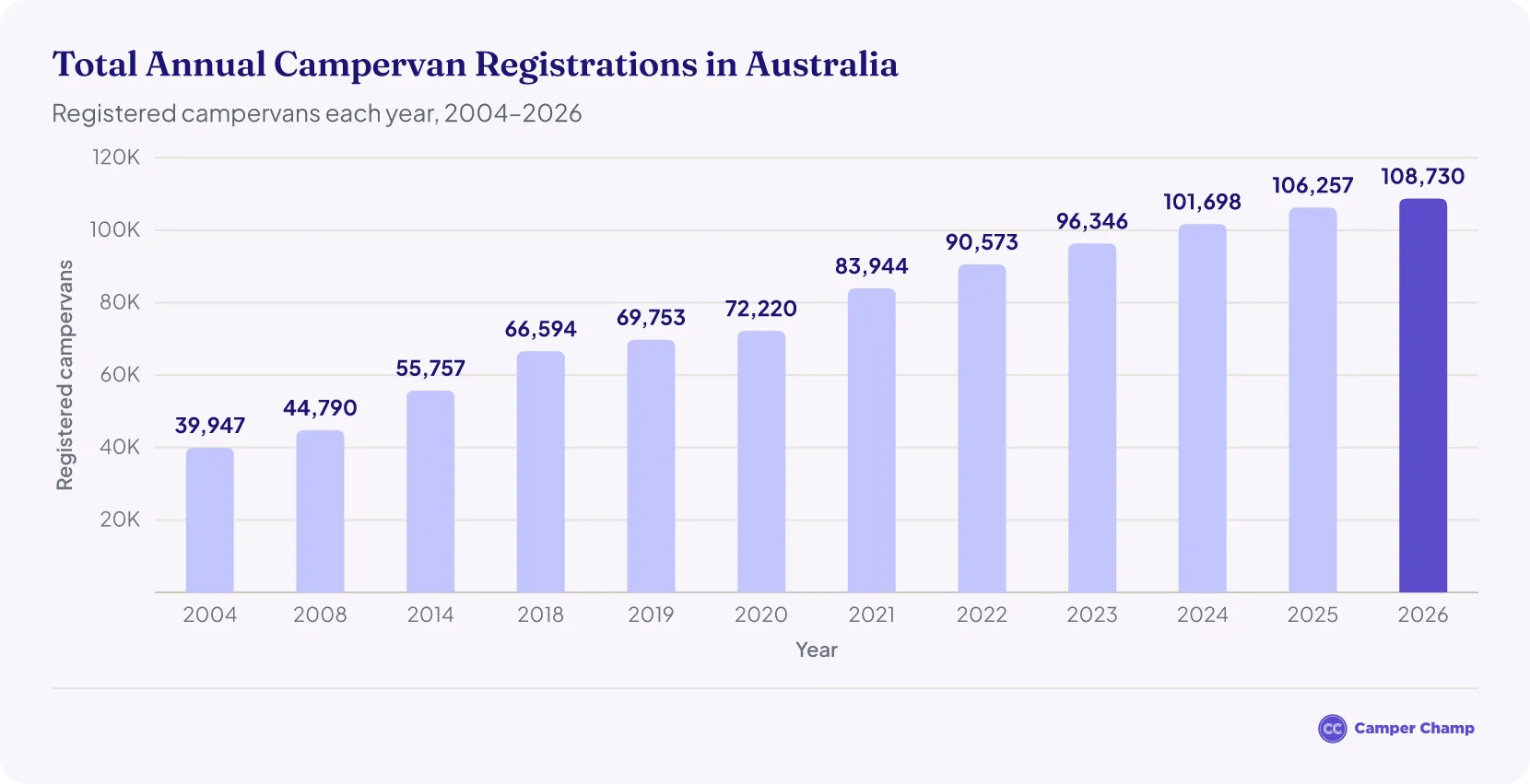
Campervan registrations in Australia have more than doubled over the past two decades, from about 40,000 in 2004 to about 109,000 in 2026.
At a Glance
- 108,730 campervans were registered in Australia in January 2026, up 2.3% on 2025.
- Campervan registrations have grown 172.2% since 2004.
- New South Wales, Queensland and Victoria hold over 85% of campervans, while Tasmania has the most per person at 10.6 per 1,000 people.
- Caravans make up about 89% of Australia's 972,070 registered caravans and campervans.
- Entries of new motorhomes and campervans rose 36.1% year-on-year in July 2026.
- Hiring is usually cheaper than owning if you travel less than about 4 to 8 weeks a year.
- Caravan and camping travellers spent A$12.6 billion in 2025.
How many campervans are registered in Australia?
There were 108,730 registered campervans in Australia as of January 20261.
- That is up 2.3% from 106,257 in 2025 and 55.9% from 69,753 in 2019.
- Over the past 22 years, registrations have risen 172.2%, from 39,947 in 2004.
Figures from 2021 onwards use a new count by the Bureau of Infrastructure and Transport Research Economics (BITRE), while earlier years come from the Australian Bureau of Statistics (ABS) Motor Vehicle Census, so growth across 2021 is not strictly comparable.
How does campervan ownership vary by state?
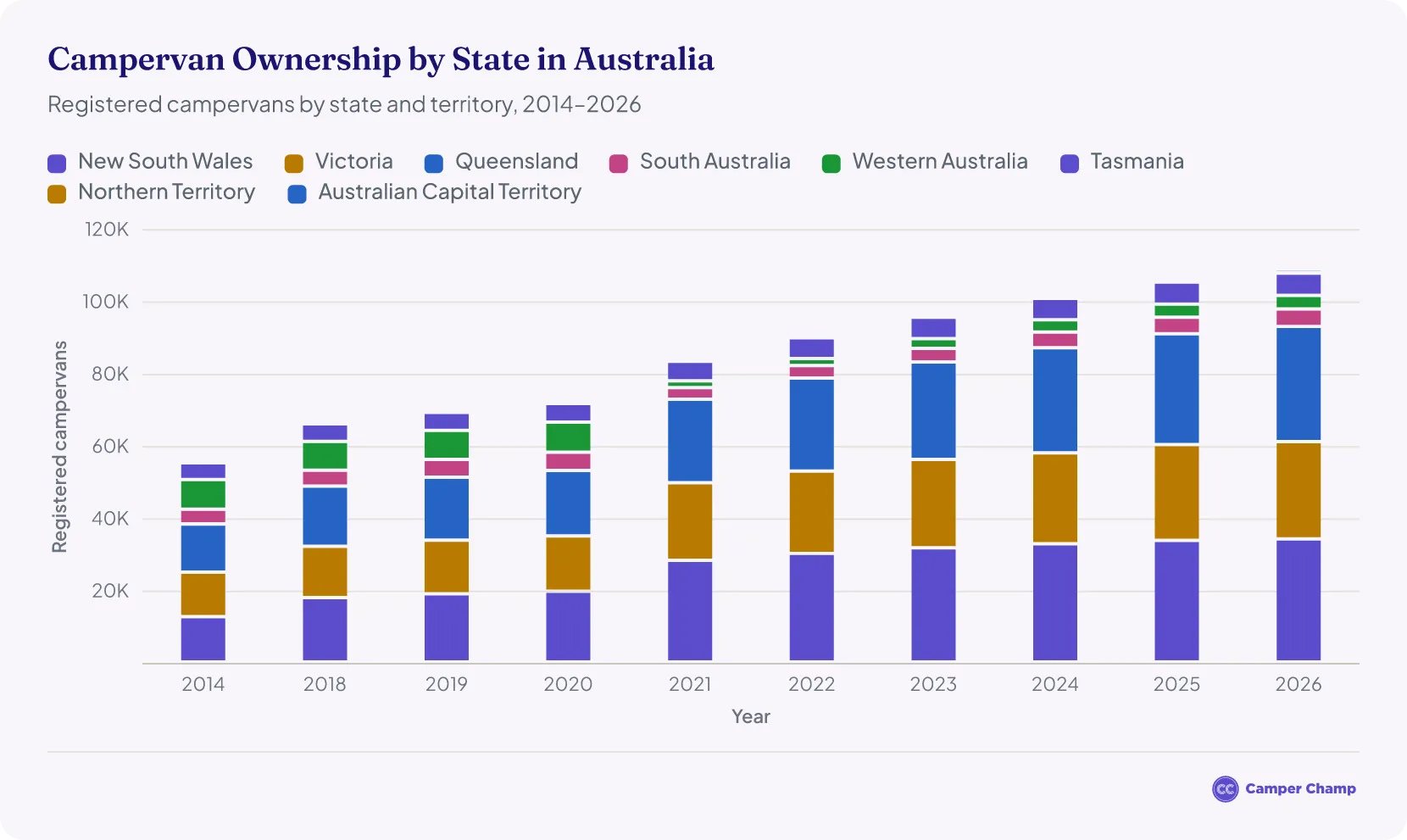
Australia’s total campervan registrations increased from 55,757 in 2014 to 108,730 in 2026, a 95.0% increase.
- Most states and territories grew over that time. Western Australia and the Northern Territory are the exceptions, largely because registrations have been counted differently since 2021.
- Ownership per person is highest in Tasmania (10.6 per 1,000 people) and Queensland (5.6), well above the national average of 3.9.
Which states have the highest campervan ownership?
New South Wales, Queensland and Victoria have the highest campervan ownership.
- Together they hold over 85% of Australia's registered campervans, with more than 92,000 in 2026.
Which states have the lowest campervan ownership?
The Northern Territory, the Australian Capital Territory and Western Australia have the lowest campervan ownership.
- Campervan ownership in the Northern Territory has decreased overall since 2014 (from 234 to 185), but numbers increased by 10.1% in 2026.
- South Australia is just above them, with campervans up 5.7% from 4,576 in 2025 to 4,835 in 2026.
- Measured per person, Tasmania leads the country, with about 11 campervans per 1,000 people.
Which states saw the largest increase since 2014?
New South Wales and Queensland have grown the most over the past 12 years.
- New South Wales increased by 171.6% (from 12,538 to 34,049).
- Queensland grew by 139.4% (from 13,311 to 31,867).
- Part of these rises reflects the 2021 change in counting method, so earlier years are not strictly comparable.
| Registered Campervans Across Australia | |||
|---|---|---|---|
| State/Territory | 2025 | 2026 | Per 1,000 people (2026) |
| New South Wales | 33,683 | 34,049 | 3.9 |
| Victoria | 26,468 | 26,924 | 3.8 |
| Queensland | 30,688 | 31,867 | 5.6 |
| South Australia | 4,576 | 4,835 | 2.5 |
| Western Australia | 3,636 | 3,750 | 1.2 |
| Tasmania | 6,096 | 6,150 | 10.6 |
| Northern Territory | 168 | 185 | 0.7 |
| Australian Capital Territory | 942 | 970 | 2.0 |
| Australia (Total) | 106,257 | 108,730 | 3.9 |
What are the demographics of campervan owners in Australia?
Australia's campervan owners range from young families and remote workers to retirees. The owner figures below come from the Caravan Industry Association's RV Consumer Report 2018, a survey of current and former RV owners and potential buyers.
- Average Owner Age: The average RV owner (caravans and campervans) was 33 years old in 2018.3
- Family Ownership: 42% of RV owners had children under 15 living at home.3
- Income Range: RV owners had an average income of A$48,000 to A$72,000.3
- Household Ownership: 1 in 13 Australian households had a registered RV in 2018.3
- Traveller Age: Travellers aged 30 to 54 took 43% of caravan and camping trips in 2025, and those aged 55 and over took 34%.4
What are the most popular campervan types in Australia?
Caravans dominate Australia's RV market, but motorhomes and campervans are the fastest-growing type.
- Motorhomes and campervans: Entries of new motorhomes and campervans jumped 36.1% year-on-year in July 2026, from 269 to 366 vehicles, bringing the January–July 2026 total to 2,390.5
- Top motorhome and campervan makes: Jayco led from January to July 2026 with 651 entries, followed by Avida (344), Avan (240), Talvor (147) and Sydney campervan specialist Frontline (88).5
- Caravans: Still by far the most common RV. Australian manufacturers built 18,438 caravans in 2025, up 7.3%, and towable RVs made up 96% of local RV production.6
- Van conversions: Ford Transit conversions are among Frontline's biggest sellers, including the newly released battery-electric Transit campervan.5
- Other types: Coach-built motorhomes add a bathroom and more beds on a larger chassis, 4×4 campers are built for off-road travel, and camper trailers are a lighter towable option.
Top motorhome and campervan makes in Australia (January–July 2026)
| Make | Entries (Jan–Jul 2026) |
|---|---|
| Jayco | 651 |
| Avida | 344 |
| Avan | 240 |
| Talvor | 147 |
| Frontline | 88 |
How much does it cost to own a campervan in Australia?
Owning a campervan means a large upfront cost plus ongoing expenses. The ranges below are typical market estimates, not official figures, and real costs vary by model, state and use.
Purchase Price
- New campervans – A$110,000 to A$150,000 (2024 prices). Entry-level models can cost less, while premium or custom-built vans can cost more than A$150,000.
- Used campervans – A$40,000 to A$80,000. Older or smaller vans sell for less, while well-kept or converted vans fetch more.
Depreciation
- A new campervan loses around 20-25% of its value in the first year, then about 5-10% a year. How fast it drops depends on brand, maintenance, mileage and market demand.
Maintenance & Running Costs
- Servicing, repairs and consumables cost several hundred dollars a year.
- Fuel averages A$16-A$30 per 100 km.
- Insurance costs A$500-A$800 a year.
- Registration, including compulsory third-party insurance, costs about A$800 to A$1,100 a year in Victoria and Queensland (2026 rates)7, depending on the vehicle and where it is kept.8
- Renting a storage space adds A$500-A$1,000 a year.
How long do Australians keep their campervans?
How long people keep a campervan depends on why they bought it and how their lives change. The ranges below are typical estimates, not survey figures.
- Long-Term Use: Many owners see a campervan as a long-term purchase and keep it for 5-10+ years.
- Short-Term: Some Australians buy a campervan for one long trip, such as the “Big Lap”, and sell it after 1-3 years.
- Upgrade Cycle: Others trade up every 3-5 years for newer features.
- Resale Value: A well-maintained campervan keeps about 50-60% of its original value after 5 years and 30-50% after 10 years.
How many campervans are sold each year in Australia?
Most new RVs coming onto the Australian market are towable caravans and camper trailers, with motorised campervans and motorhomes only a small share.
Is it cheaper to rent or buy a campervan in Australia?
Renting is usually cheaper if you travel less than about 4 to 8 weeks a year. Typical campervan hire costs about A$150 to A$200 per day in Australia's main cities.
- Hire prices: Daily rates run at about A$150 in Sydney, A$152 in Melbourne, A$148 in Brisbane, A$166 in Adelaide, A$175 in Perth and A$197 in Hobart, for 7-day hires of budget and mid-range campervans picked up between November 2026 and October 2027.
- Cost of owning: Insurance, registration, storage and servicing add roughly A$2,000 to A$3,500 a year. A used campervan worth A$60,000 also loses about A$3,000 to A$6,000 a year in value at 5–10% annual depreciation.
- Break-even: Those yearly costs of about A$5,000 to A$9,500 pay for roughly 30 to 58 days of hire at around A$165 per day, before fuel, which you pay either way.
Owning makes more sense for long trips like the Big Lap or several months on the road each year. These are estimates from CamperChamp's campervan hire price data (October 2026) and the ownership cost ranges above.
How many caravans and RVs are registered in Australia?
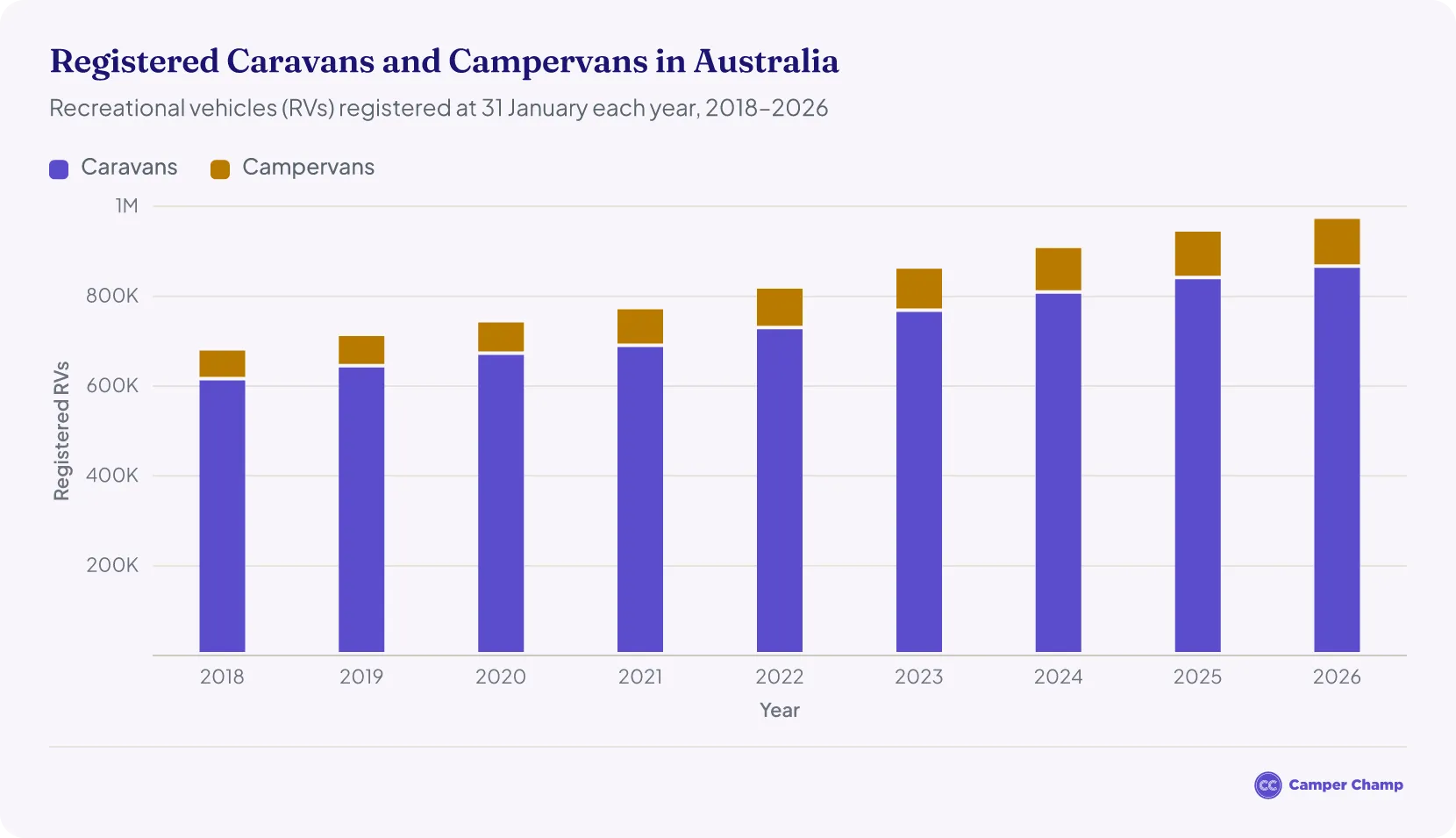
Australia had 972,070 registered caravans and campervans as of January 2026. About 89% are towable caravans, and self-propelled campervans and motorhomes make up the other 11%.
- There were 108,730 campervans and 863,340 caravans as of January 20261, a combined total up 36.6% since 2019.
- Registrations grew 4-5% a year before the pandemic and 6.0% from 2021 to 2022, passing 900,000 in 2024.
How do caravan and campervan prices compare?
Caravans
- New caravans – A$45,000-A$150,000+
- Average family caravan – A$55,000-A$65,000
Campervans
- Campervans cost more, with many models exceeding A$100,000.
What is the impact of campervan ownership on the tourism industry?
- Economic Impact: RV-related spending (manufacturing, sales and tourism services) contributed around A$27 billion annually4.
- Travel Expenditure: Domestic travel spending by caravan and camping travellers reached A$12.6 billion in 20251, well above the pre-pandemic A$10.2 billion in 2019. The 2025 figure comes from Tourism Research Australia's new survey, so the two years are not strictly comparable.
- Regional Boost: 83% of spending while travelling is in regional areas (2025)1, supporting local businesses and infrastructure.
- Rental Market: The rental sector includes hire companies and private owners renting out their campervans and motorhomes.
How many caravan and camping trips do Australians take?
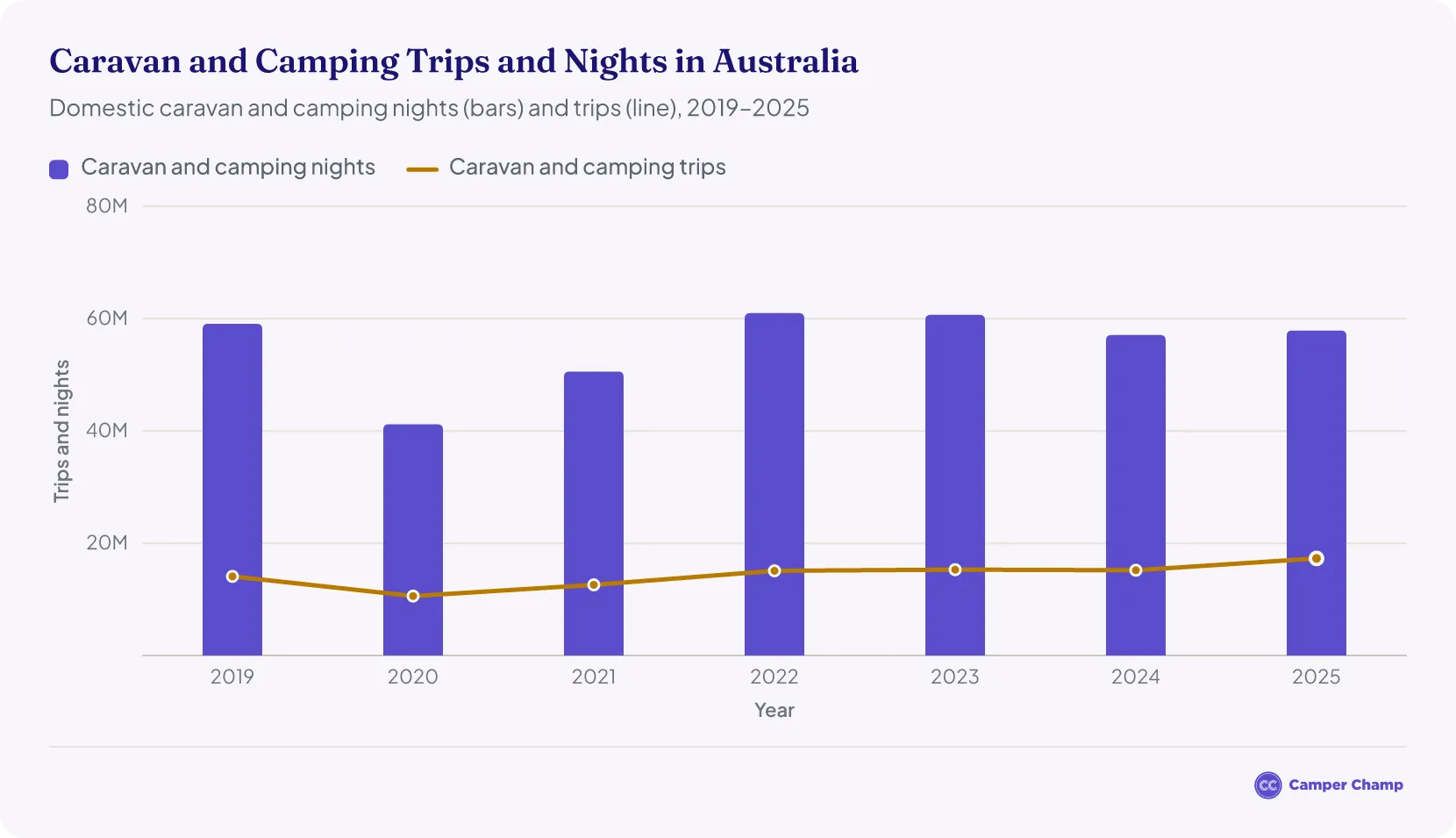
Australians took 17.3 million caravan and camping trips (57.9 million camping nights) in 20251.
- That is 22.8% more than the 14.1 million trips in 2019, though the 2025 figures come from Tourism Research Australia's new survey, which also counts glamping.
- Campervans are popular with small groups of 2-4 people, as seatbelt rules limit how many can travel in one.
- Trips range from weekend getaways to journeys of several months.
FAQs
Which Australian state has the most campervans per person?
Tasmania has the most, with 10.6 campervans per 1,000 people in 2026, almost three times the national average of 3.9. Queensland is next at 5.6 per 1,000.
What is the difference between a campervan and a motorhome?
A campervan is usually a van conversion with beds and a kitchen, such as a Ford Transit. A coach-built motorhome is larger, sits on a bigger chassis and adds a bathroom and more beds. Both are self-propelled, unlike caravans and camper trailers, which are towed.
Can you buy an electric campervan in Australia?
Yes. Sydney campervan specialist Frontline has recently released a battery-electric version of its Ford Transit campervan.5
Why did campervan numbers fall in Western Australia?
Mostly because of a change in how vehicles are counted. From 2021, registration figures come from BITRE's new method instead of the ABS Motor Vehicle Census, and Western Australia's count dropped from 8,336 in 2020 to 1,851 in 2021 on the new basis. It has risen every year since, reaching 3,750 in 2026.
Are campervans becoming more popular in Australia?
Yes. Campervan registrations rose 55.9% between 2019 and 2026, and entries of new motorhomes and campervans were up 36.1% year-on-year in July 20265, even as the caravan market cooled.
Campervan hire in Australia
- Adelaide
- Alice Springs motorhome hire
- Brisbane motorhome hire
- Broome campervan rental
- Cairns motorhome hire
- Campervan hire in Gold Coast
- Campervan hire in Melbourne
- Campervan hire in Perth
- Darwin motorhome hire
- Devonport
- Hobart motorhome hire
- Launceston
- Sydney campervan rental
- Tasmania
References
- Caravan and Camping Data (Tourism Research Australia) · Tourism Research Australia ↑ b c d e
- ABS, National, state and territory population, March 2026 · Australian Bureau of Statistics ↑
- Ground-breaking new research shows RV ownership in a new light (RV Consumer Report 2018, Caravan Industry Association of Australia) · caravanindustry.com.au ↑ b c d
- Australian caravan and camping industry statistics (Caravan Industry Association of Australia, updated 8 September 2026) · caravanindustry.com.au ↑ b c d
- Caravan market cools as motorhomes surge (caravancampingsales.com.au, 23 September 2026) · caravancampingsales.com.au ↑ b c d e f
- State of the Industry 2026: Resilience in a changing market (Caravan Industry Association of Australia) · caravanindustry.com.au ↑
- Vehicle registration fees (VicRoads) · vicroads.vic.gov.au ↑
- Registration fees: cost (Queensland Government, Department of Transport and Main Roads) · qld.gov.au ↑
- Registered Campervans in Australia 2021–2024 (BITRE Road Vehicles, Australia) · bitre.gov.au
- Registered Campervans and Caravans in Australia 2004–2024 (ABS Motor Vehicle Census) · Australian Bureau of Statistics
- RV Sales and Caravan Statistics in Australia (2022–2024) · caravanstats.com.au